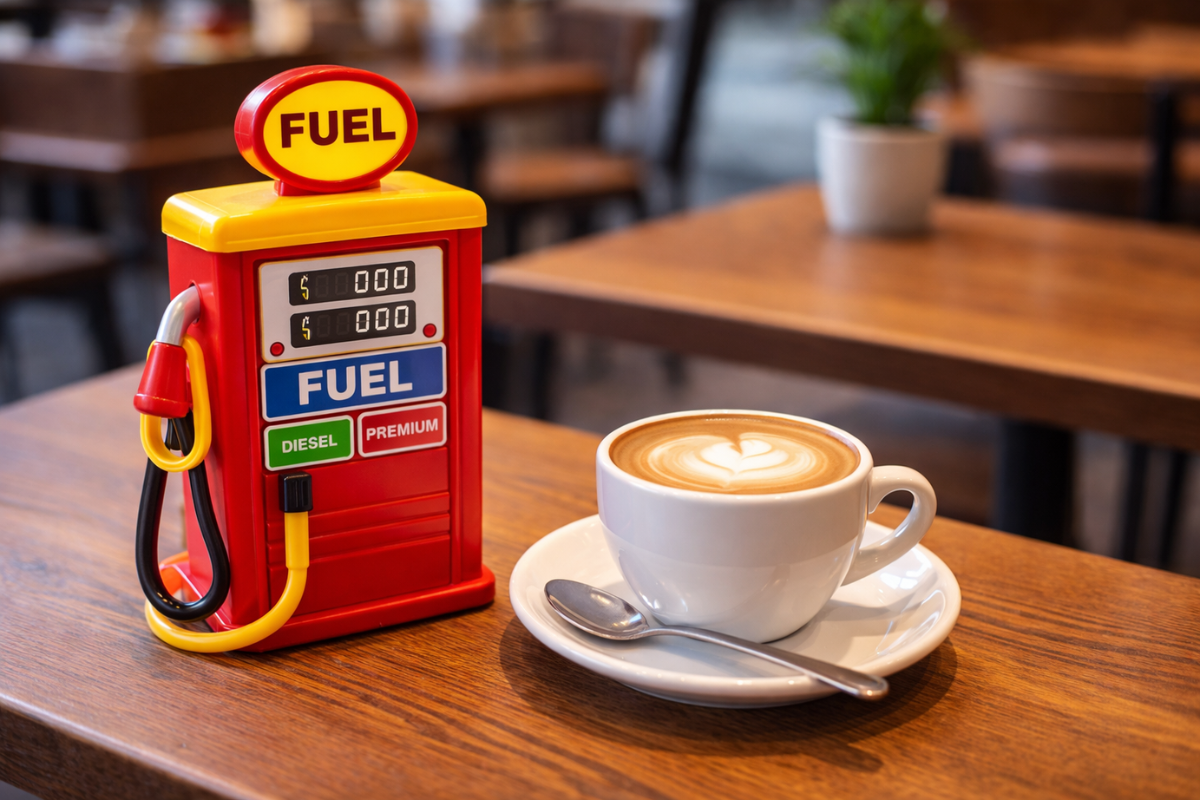
For cafés and restaurants, this is not just a fuel story. It is a margin story, a demand story, and potentially a survival story.
A delivery arrives late, costs a little more than last week, and the invoice does not quite line up with what was expected. Nothing dramatic on its own, but it keeps happening. That is how this current phase is likely to show up for operators.
It is easy to read rising fuel prices as a consumer problem first. Fewer discretionary coffees. Fewer second drinks. A softer Friday night. That will be part of it, but it misses the bigger issue. Petrol does not just change how customers feel. It changes how hospitality businesses function. MBIE is already warning that petrol and diesel prices are expected to stay high and may continue to rise in coming weeks, and it is explicitly telling businesses to plan ahead for higher fuel costs.
That matters because fuel works its way through nearly every line of a hospitality P&L. Freight lifts. Supplier delivery costs lift. Packaging becomes more expensive because petrochemical inputs are under pressure. Food costs come under strain through transport and diesel-heavy production and distribution. Even if a café never sees a formal surcharge from a supplier, it still gets hit. The increase simply arrives disguised across cartons, cups, ingredients, cleaning products and contractor invoices.
That is why the current market is starting to feel uncomfortably similar to COVID-era disruption, but without the buffer of government support. During COVID, operators had demand shocks, staffing disruption and supply volatility, but there was at least some recognition from the government that businesses were being hit by forces outside their control. This time, the pressure looks more like a rolling commercial squeeze. Costs move first. Customers pull back second. Relief does not arrive at all.
Across the sector, operators are already talking in more defensive terms. The conversation is shifting from growth to protection. Some are quietly modelling what a 30 to 40 percent drop in turnover would look like, not because it is guaranteed, but because it is plausible enough to plan for. That alone tells you where sentiment is sitting.
This is where the response needs to shift from observation to action. The instinct in periods like this is often to look inward first, trim labour, tighten rosters, push prices where possible. That will happen, but it is only part of the equation. The more material opportunity may sit upstream, in how operators work with suppliers.
There is a case for reopening conversations that, in more stable periods, tend to sit on autopilot. Pack sizes, delivery frequency, minimum order quantities, product specifications, even menu inputs that have simply carried over year to year. Not every supplier will have room to move, but some will, particularly if the conversation is framed around volume certainty, simplified ranges or longer-term alignment rather than one-off price pressure.
The menu itself becomes part of that discussion. The 2026 menu is unlikely to reward complexity. It will favour dishes that travel well across dayparts, use overlapping ingredients, and minimise waste. Proteins that can flex across multiple items. Prep that can be centralised. Garnishes that add cost without driving perceived value start to come under scrutiny. It is not about stripping back to basics, but about making sure every element earns its place commercially.
There is also a practical conversation to be had around substitution and sourcing. Local alternatives where supply is more stable. Slight spec adjustments that reduce cost without compromising the dish. Even small shifts, repeated across a menu, can change the margin profile more than a headline price increase that risks pushing customers away.
For suppliers, this period is not without risk either. Volume volatility, rising input costs and customer hesitation all feed back up the chain. That creates a shared incentive to find workable ground. Operators that approach suppliers with a clear view of their numbers and a willingness to collaborate rather than simply negotiate are more likely to find solutions that hold.
The difficult part is timing. Even if the Iran conflict ended tomorrow, that would not mean an immediate unwind. Supply contracts, freight rates, packaging costs, insurance settings and buying behaviour do not snap back overnight.
So the message for cafés and restaurants is not to wait for normality. It is to model for disruption now, and to do it in partnership where possible. Assume turnover softens. Assume some costs stick longer than expected. Use that as a base to rework menus, reset supplier conversations and strip out inefficiencies before they become critical.
The risk is not simply higher petrol. The risk is trying to manage it alone, when parts of the solution sit outside the four walls of the business.
Subscribe to the Restaurant & Café newsletter for weekly industry updates and event coverage.