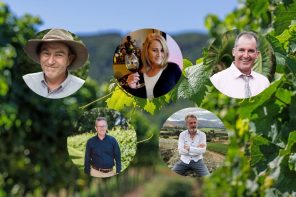
Willie Trew first became interested in winemaking after working in a neighbouring vineyard beside his family farm in Hawke's Bay.
Following this initial stint, Trew worked in Central Otago for three years, where he realised to pursue a bachelor's course in Viticulture and Oenology, which he completed at Lincoln University.
Trew moved to Greystone, where he worked under Dom Maxwell. Between working during harvest seasons, Trew travelled into the Northern Hemisphere to gain a broader understanding of the industry.
On his return, Trew took the role of assistant winemaker at Man O' War vineyards on Waiheke, where he learned under Duncan McTavish for five years.
Trew built a deep understanding of the industry after gaining overseas experience in France and the US.
"Exposure to well-established wine families and estates like Domaine de Montille and Domaine Serene gave me hugely valuable experience that I have used to develop my career as a head winemaker," said Trew.
These days, Trew is at the Boneline. A family-owned estate planted in 1989 in the Waipara Valley in North Canterbury. It includes 18ha of producing vines, in which the site comprises three different river terraces and four distinct microclimates.
Known for producing cool climate varieties such as Cabernet Sauvignon, Cabernet Franc, and Merlot.
Aiming to showcase fruit, vintage, and site to the highest level, Trew dictates and guides his winemaking decisions on these three factors.
Many of Trew's methods use tradition as a pillar of inspiration to produce wine. However, he is not dogmatic in his practices and enjoys utilising new techniques.
Instead, Trew seeks innovation in how the process can become more efficient by reducing water, CO2, and energy usage.
Alongside this, Trew attempts to mitigate the effects of climate change and challenge the elements of tradition with modern techniques.
A unique characteristic of Boneline wines is the minerality, often perceived as crushed salt on the palate.
"It's in all the wines and definitely a positive characteristic. It gives all the wines a crisp cleaning feel on the palate," said Trew.
'
Regarding the bottling process, Trew is not pressured and is left with a degree of freedom. The lack of pressure allows the phenolics to evolve, provided Trew monitors the wine effectively.
This results in Trew creating a bottling schedule well in advance each year post-harvest, meaning all suppliers and the local mobile contractor are well-prepared.
Recent innovations such as mobile testing units have been used to get the analysis done more efficiently, resulting in quicker decision-making processes that are both accurate and cost-effective.
Trew mentioned that implementing different strategies for all the wines is a crucial factor in controlling the quality and taste of the wines. Limiting or adjusting exposure to oxygen or using sulphur are two processes that require a watchful eye.
Trew reads industry journals and publications and attends industry events and seminars to stay current on modern trends and developments.
The future of winemaking is becoming increasingly value-based, with customers aligning their purchases with their values, which is more about a sustainable future.
For those aspiring to travel and learn more about the industry, Trew advises to keep moving forward despite the roadblocks that arise.
"Building a career is always challenging. It's crucial to be passionate, tenacious, patient, and not afraid to put in the work to nurture relationships over time," said Trew confidently.