USA | Starting in August, Starbucks will lead a city-wide collaborative reuse project in Petaluma, California, to make reusable cups the default option for to-go drinks. Most reusables tests focus on customers “opting in.”
The Petaluma Reusable Cup project is an extensive collaboration between public and private entities, including industry competitors, working together for the greater good to help shape consumer habits and cultural norms.
In addition to Starbucks, brands like The Coca-Cola Company, PepsiCo, Peet’s Coffee and Yum! Brands are participating alongside local cafes and restaurants, city and county governments, and community and environmental advocacy groups. Starbucks licensee partners Target and Safeway will also take part.
The project is an initiative of the NextGen Consortium. Starbucks is a founding member and will be led by the Center for the Circular Economy at Closed Loop Partners. NextGen Consortium aims to reimagine how food is packaged, accelerate sustainable solutions and help reduce waste on a global scale.
Eight Starbucks stores will participate in the reusable cup test for three months. In this test, 30 restaurants and cafes in Petaluma will offer customers reusable cups for all hot and cold beverages.
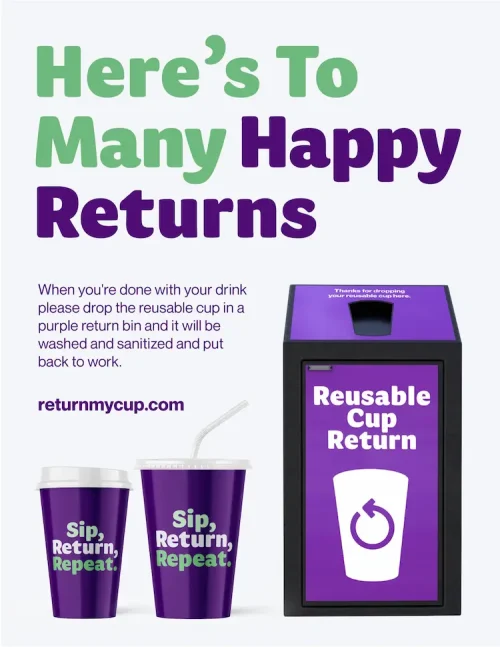
Customers can return their cups at one of more than 60 purple drop-off return bins at Starbucks cafes and participating businesses throughout the city. The cups will then be professionally cleaned, sanitised, and recirculated for use again.
The test cups are branded purple. The Starbucks cup will be white on the front and purple on the back, and the fill line markings will be retained specific to Starbucks beverage recipes. All reusable cups in the test are made from BPA-free polypropylene.

Helen Kao, Starbucks' director of reusables, said the focus has been on ubiquity and convenience. By making reusable cups the default option, with widespread return points and community-wide communications, Starbucks aims to support customers in building the habit of returning their cups.
“Last year, Starbucks conducted a similar test in the same area, but we tested ourselves,” said Kao.
“This year, we expanded on that by partnering with NextGen Consortium to drive systems change. What if we saturated a community, and reusables became the cultural norm? It’s an ecosystem of global brands, local businesses, city leaders and community groups working together. The industry realises it’s easier to partner than do things alone.”
The project is part of Starbucks' environmental promise to give more than it takes and to eventually make all customer-facing packaging reusable, recyclable, or compostable. The test will measure consumer engagement when reusable cups are the default option and provide insights on how this model could work on a larger scale to reduce the number of single-use cups. NextGen Consortium estimated that more than 50 billion single-use cups are thrown away annually across the U.S.
Petaluma was chosen as a test market because of its dense downtown layout, high walkability, and overall climate, which support reuse and policies phasing out single-use packaging.